Textiles & Everyday Life
From Bath to Bedroom: Choosing a Natural-Fiber Robe
A robe may be the least hurried garment in the house. Yet the hour after bathing, when skin is damp and the room has opinions about the weather, puts fabric to a surprisingly exacting test. Fiber, weave, and weight determine whether a robe absorbs, insulates, dries promptly—or simply hangs there, looking like an excellent idea.
Published October 21, 2026
There is a brief interval after a bath when the day has not quite resumed. The towel has done what it can; the hair is wet, the mirror has clouded, and somewhere a phone is beginning to insist that ordinary life continue. A robe steps into this interval. It is not quite a towel and not quite clothing, though it borrows from both. Its success depends less on grand claims of luxury than on a practical question: what should the fabric do when it meets a person who is still damp?
The answer varies. Someone stepping from a bath in a cold house may want a substantial, enveloping layer. Someone moving from shower to a warm bedroom may prefer a light robe that dries between uses without taking over a hook. A robe worn mainly for breakfast or evening lounging has still another job. Before comparing colors, collars, or the little belt loops that are often asked to bear more responsibility than their size suggests, it helps to decide which of these lives the robe will lead.
Natural fibers are often appealing because they bring distinct, understandable properties to the choice. Cotton is absorbent and familiar; linen is airy and tends to feel pleasantly crisp; wool offers warmth and can handle moisture in ways that differ from cotton. But “natural” is not a performance guarantee. A cotton robe can be quick-drying or slow, soft or stiff, depending on the yarn, weave, pile, weight, and finishing. The fiber is the beginning of the story, not its conclusion.
Start with the moment you put it on
A post-bath robe is often expected to perform two tasks at once: take up some moisture and keep the body comfortable while the remaining moisture evaporates. These aims are related, but they are not identical. A thick, plush fabric can feel reassuringly warm and absorbent, yet remain damp for longer after use. A lighter, open weave may dry more readily and feel less cumbersome, but offer less of the cocoon-like warmth people associate with a hotel robe.
Think through the sequence, rather than picturing the robe in isolation. Do you towel-dry thoroughly before putting it on, or do you expect it to do some of the towel’s work? Is the bathroom ventilated? Will the robe be worn in a chilly house, or carried into a sunlit bedroom? Does it need to be comfortable for a few minutes, or for an entire slow morning? The answers can narrow the field more effectively than a description that promises “ultimate softness,” a phrase that has been made to work overtime.
For a robe used mainly after bathing, absorbency matters. Cotton is a common choice because its fibers take up water readily and can be woven or knitted into constructions with very different textures. A terry robe, with its loops, has more surface area to meet moisture than a smooth, flat weave. That can make it feel towel-like and substantial. The trade-off is that a dense robe can be bulky to wear and may take longer to dry than a lighter garment.
For a robe used mainly over pajamas or ordinary clothes, absorbency may be a secondary concern. In that setting, drape, warmth, and ease of movement matter more. A lighter cotton weave can feel relaxed without creating the impression that one has taken the bath linen along for the rest of the day. There is no universal winner; there is only the robe that suits the routine it is actually going to enter.
Cotton, from airy to enveloping
Cotton’s reputation as an easygoing household fiber is deserved, with a few qualifications. It is generally comfortable against the skin and readily absorbent. It can also tolerate regular laundering better than some delicate fibers, provided the care label and the construction are respected. But cotton is a large family of fabrics. A crisp percale, a soft jersey, a textured waffle, and a looped terry may share a fiber and have little else in common once they are on the body.
Waffle and other textured weaves are worth considering when the aim is a lighter robe with some capacity to absorb moisture. Their raised and recessed surfaces can give the fabric a sense of texture without the dense pile of terry. Depending on yarn, weave, and weight, such robes may be easier to pack away and may dry more quickly than a thick, heavy construction. The trade is usually straightforward: less bulk, and often less of the immediate plushness some people want after a shower.
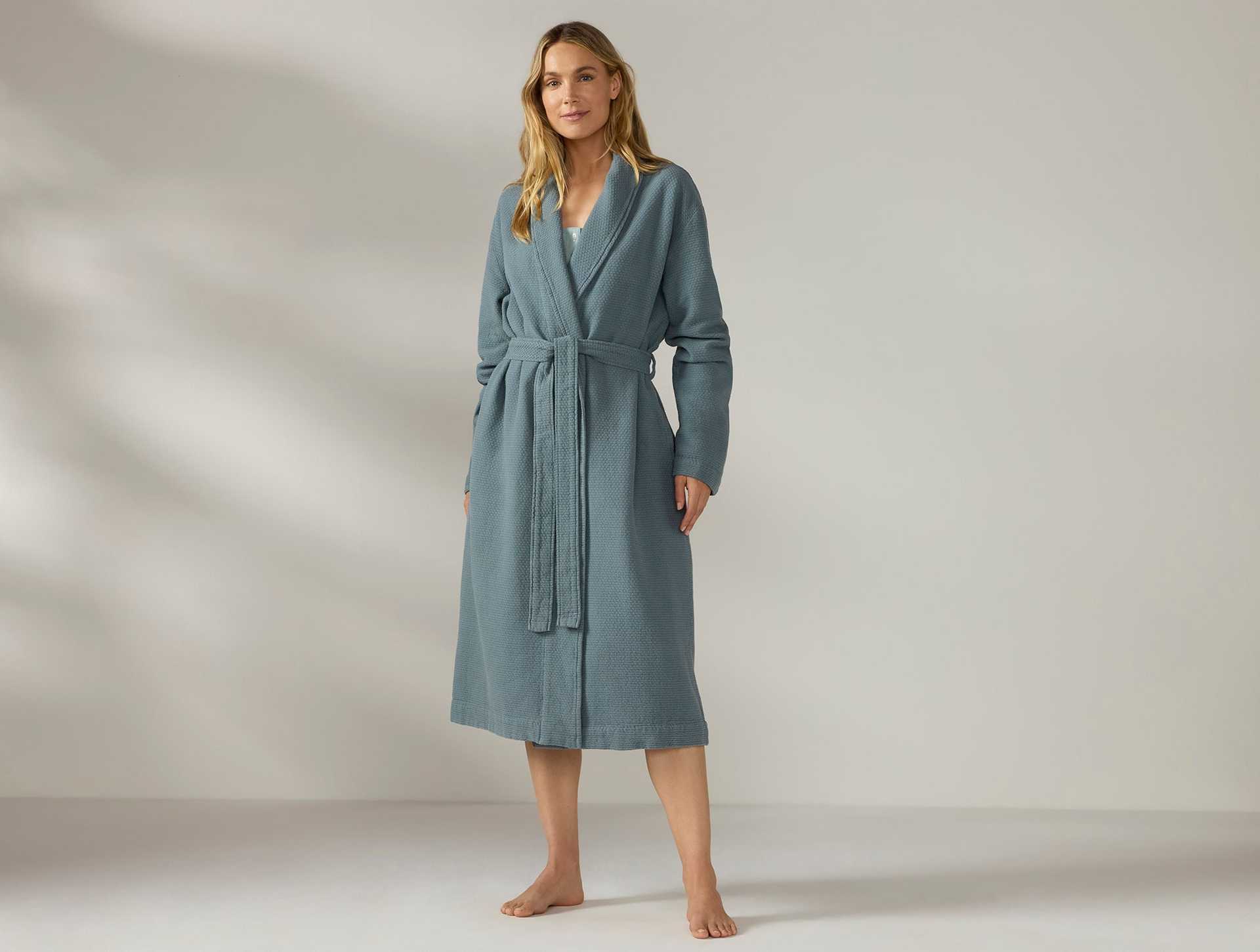
Organic cotton describes how the cotton was grown and certified, not how thick, soft, or thirsty the finished robe will feel. Construction still does the close work. One example is the Women’s Adriatic Organic Robe, made from 100% organic cotton grown and woven in Turkey. Its relaxed, lightweight weave is described as naturally absorbent, while garment dyeing gives it a soft, textured feel. It has on-seam pockets and a waist belt, and its listed care instructions call for a cold, gentle wash with like colors and low-temperature tumble drying. Those are useful details to consider alongside the fiber itself: a robe that suits both the body and the laundry routine stands a better chance of being worn often.
The distinction between organic fiber and a finished garment’s broader environmental impact deserves some care. A certification can tell you something about the standard it covers; it does not, by itself, answer every question about dyeing, transport, durability, or the number of years the robe will be used. Labels are useful evidence, not a substitute for reading the rest of the garment’s story.
The weave is the part you feel first
People often shop by fiber and discover the weave only when the parcel arrives. This is a little like choosing a room by the type of wood in its floor and then finding that the walls are, unexpectedly, very close together. Weave shapes surface, air movement, weight, and drape. It also influences how a robe feels as it moves—whether it follows the body easily, catches at the elbows, or has the stiffness of a garment still negotiating its first wash.
Terry is the familiar choice for a robe whose first assignment is to absorb water. Its loops create a soft, towel-like surface, and a heavier terry robe can feel warm and substantial. But the same loops that give it absorbency hold more water than a smooth, lightweight fabric. If a robe will be used several times between washes, it needs somewhere airy to dry; folded damp in a basket, even a handsome natural fiber will have an unfortunate afternoon.
Waffle weaves offer a different balance. Their textured cells can make a robe feel airy and less bulky than dense terry, while still offering some absorbency. A flat weave is generally smoother and may be lighter, though it will not provide the same towel-like sensation. Jersey, with its knitted construction, can be soft and flexible, closer in feel to a casual garment than to a bath sheet. Each construction has a temperament. The useful question is not which one is best in the abstract, but which one feels pleasant under the conditions in which you intend to wear it.
When you cannot handle a robe before buying, look for specific descriptions rather than relying on adjectives alone. “Lightweight,” “looped,” “waffle,” “knit,” and “woven” convey more about construction than an unqualified promise of softness. Product specifications may also state fiber content, country of origin, fit, and care instructions. These details do not replicate the experience of touching the fabric, but they can help you make a less mysterious decision.
Weight, warmth, and the weather indoors
Weight is not simply a question of whether a robe feels heavy in the hand. It affects warmth, coverage, ease of movement, and how long the garment may take to dry. A thick robe can be welcome in winter, especially in a cool bathroom or a house with a draft that seems to know everyone’s schedule. In a heated room, the same robe can feel like an unnecessary layer before breakfast has even begun.
Consider the robe’s role across seasons. If it is primarily a winter garment, a heavier cotton construction may be worth the additional bulk. If it will hang beside a shower and be worn repeatedly through the year, a lighter weave may be more versatile. Some people keep one robe for each use: a thirsty, warm option for the cold months and a thinner one for travel or summer. This is not a requirement of civilized life. It is simply a practical solution for anyone who has found themselves sweating through a garment designed, with great optimism, for another climate.
Fit contributes to warmth as well. A generous robe can layer over clothing and feel easy to move in, but excessive volume may drag at the sleeves or make the belt difficult to secure. A closer cut can feel tidy, though it may limit layering. Check sleeve length, robe length, and the position of pockets if those details matter to your routine. A belt that stays comfortably tied and pockets placed where your hands naturally fall can make more difference than an elaborate collar.
Absorbency is only half of drying
It is tempting to judge a robe solely by how well it handles the first few minutes after a bath. But the garment also has to dry itself. A very absorbent robe can be pleasant to wear and inconvenient to keep ready if it remains damp for hours in a crowded bathroom. Drying time depends on more than fiber: fabric thickness, weave, ventilation, humidity, and how the robe is hung all play a part.
Give the robe room to breathe. Hanging it fully open, rather than folded over a narrow hook, exposes more of the fabric to circulating air. A well-ventilated room helps; a steamy bathroom with no airflow does not. If the robe is still damp when you next reach for it, the problem may be the drying arrangement rather than the garment’s basic quality. A robe is an article of clothing, but it is also a small piece of household infrastructure.
There is a useful distinction between a robe that absorbs water from the skin and one that feels dry quickly after laundering. A fabric’s comfort while worn does not predict every part of its drying behavior. A plush, dense textile may hold more moisture and take longer to dry. A light, open textile may lose moisture sooner, while providing less coverage. The best match depends on whether you value immediate absorbency, quick turnaround, or a balance between the two.
Care instructions are part of the design
Care is not the footnote at the end of a robe’s description; it is part of the garment’s character. Before choosing, consider how often you are willing to wash it and what your household laundry can accommodate. Machine-washable cotton is convenient for many routines, though temperature, detergent, drying method, and color separation still matter. A robe that requires more specialized care may remain a pleasure to own, but only if those instructions fit the life around it.
Follow the care label, which reflects the specific garment’s fiber and construction. For cotton robes, a gentle cycle and moderate temperatures can help reduce unnecessary stress on the fabric. Avoid using more detergent than needed; residue can affect the hand of some textiles. If the instructions recommend low-heat tumble drying, high heat is not a clever shortcut so much as a negotiation the robe did not agree to. Remove the garment promptly if the label advises it, and reshape it before hanging or folding.
Wash a robe when it needs washing, rather than because a calendar has declared the week over. How often depends on use, humidity, whether it is worn over clean clothing, and personal preference. Airing it thoroughly between uses can help it remain fresh. If the robe is worn directly after bathing, regular laundering is sensible; it comes into contact with skin products, body oils, and moisture even when it appears clean.
Color can affect care in practical ways. Garment-dyed textiles may show subtle variation, an intended part of their appearance; washing with like colors helps reduce the chance of unwanted transfer. Pockets should be checked before laundering, and belts secured or removed according to the care guidance. These are not dramatic rituals. They are small acts of prevention, like closing the door softly enough that it does not wake the house.
The case for knowing what “natural” means
Natural-fiber robes are often chosen for comfort, familiarity, or a preference for materials derived from plants or animals. Each fiber has advantages and limitations, and none removes the need to consider how the finished textile is made and cared for. Cotton is plant-based, absorbent, and widely used; its feel and performance vary greatly by construction. Linen, also plant-based, is known for an airy hand and can feel more textured than cotton. Wool is insulating and can manage moisture, but it is less commonly the first choice for a robe worn straight from the bath, and its care requirements may be more demanding.
Fiber blends can alter the feel, durability, and care needs of a fabric. For a robe, it is worth looking for the exact percentages rather than assuming that a material named in a product description makes up the whole garment. The weave and finish remain important. A natural fiber may be blended with another material to change its performance, and the result should be judged on its actual composition, not on the romance of a label.
Questions of sourcing also call for precision. Look for clear information about fiber content, origin, and any certifications, and pay attention to what each claim does—and does not—cover. A country of origin may refer to where a garment was woven or assembled, while the fiber itself may come from somewhere else. A certification may set requirements for a defined part of production. Better information helps; sweeping claims rarely do.
A simple way to compare robes
When several bath robes seem plausible, compare them against the same short list. This avoids the familiar shopping phenomenon in which the softest adjective wins and all other considerations go to live elsewhere.
- Use: Is the robe intended for drying after a bath, lounging, layering, travel, or several of these?
- Fiber: What is the full fiber content, and does it suit your preferences and care habits?
- Construction: Is the fabric terry, waffle, flat woven, knitted, or another texture?
- Weight: Will its warmth and bulk make sense in the room and season where you will wear it?
- Drying: Can it hang with enough airflow between uses, and how will it dry after laundering?
- Care: Are the washing and drying instructions compatible with your routine?
- Fit: Are length, sleeves, belt, and pockets arranged for comfortable movement?
- Information: Are origin, certifications, and material details described clearly enough to assess?
It can also help to decide what you are willing to trade. A plush robe may offer more warmth at the cost of faster drying. A lightweight robe may be easier to wear through the year but less satisfying in a cold bathroom. A more particular care routine may preserve a delicate construction but make frequent use less convenient. Naming the trade-offs turns a vague search for “the perfect robe” into a decision about priorities.
From bath to bedroom—and back again
The robe is a modest garment with an unusually intimate job. It appears at the boundary between privacy and the rest of the day, and its comfort is measured in ordinary circumstances: the cool walk from the shower, the damp hair at the nape, the coffee waiting in another room. It does not need to transform any of these things. It only needs to make them more comfortable, while being easy enough to care for that it remains in rotation.
For a robe that will help with post-bath drying, begin with absorbency and the fabric’s construction. For a robe devoted to lounging, give more weight to softness, drape, and warmth. If you want one garment to do both, look for a middle ground: an absorbent but not excessively bulky cotton, a weave that feels comfortable against the skin, and care instructions you can follow without ceremony.
Then let the evidence on the label meet the evidence of your own routine. Where will it hang? How often will it be worn? Is the bathroom warm, or does the bedroom provide the real refuge? A good natural-fiber robe is not defined by a grand adjective or by the idea of luxury. It is defined by the quiet fit between material, use, and care—by the fact that, on an ordinary morning, it is the thing you reach for without having to think about it.