A guide to fibers, form, and care
Cashmere Layers for Everyday Wear: A Guide to Clothing and Accessories
Cashmere’s reputation is built on a small contradiction: it can feel almost weightless and still make a cold day more bearable. Understanding how that happens means looking beyond the hand of a garment to its fiber, yarn, knit, and intended use. The result is a more useful way to choose cashmere—one that prizes comfort and longevity over a first impression of softness.
The appeal of a light layer
Some clothes announce themselves. A stiff coat has a silhouette; a heavy sweater occupies the room before its wearer does. Cashmere often works by subtler means. A fine scarf can be folded into a pocket. A soft hat may offer welcome warmth without the bulk of a thick wool cap. A sweater can sit beneath a jacket without making the shoulders feel crowded. These are modest advantages, but modest advantages are often the ones that determine whether a garment becomes part of ordinary life.
Cashmere comes from the fine undercoat of cashmere goats. The fibers are prized for their softness and insulating qualities, but the word itself does not guarantee a particular weight, feel, or performance. Two pieces labelled cashmere may behave quite differently: one might be airy and fine, another compact and substantial. Their differences arise from fiber characteristics, yarn preparation, the way the garment is knitted or woven, and how much material is used.
That variability is useful. It means cashmere can be made into more than a single kind of winter garment. It can form a slim layer for an office or a train journey, a warm accessory for a windy walk, or a heavier knit intended to stand on its own. The practical question is not simply whether a piece is cashmere. It is what kind of cashmere object it is, and whether its construction suits the way it will be worn.
Fiber content: reading beyond the label
A fiber-content label is a starting point, not a verdict. Pure cashmere tells you that the garment is made from cashmere rather than a blend, but it does not specify the thickness of the yarn, the density of the knit, or how the piece will change with use. A blended garment may combine cashmere with another fiber to alter its resilience, texture, price, or care requirements. The proportions matter, as does the reason for the blend.
In a blend, the other fiber is not necessarily a flaw, nor is a high cashmere percentage automatically a promise of superior everyday performance. A blend can be designed to make a knit less delicate or to change its drape. But the label should be read carefully: a phrase such as “cashmere blend” tells little by itself. Look for the actual fiber percentages and consider what each component might contribute. If the garment’s composition is vague, you have less information with which to judge it.
Fiber length and fineness also influence how yarn behaves, though shoppers rarely receive a complete technical account on a hangtag. Fine fibers can create a soft hand, but softness alone is an incomplete test. A very soft surface may be appealing in a fitting room and still be poorly suited to daily friction. Conversely, a knit that feels slightly firmer at first may relax with wear. It is worth noticing how the whole garment feels—its weight, recovery, and structure—rather than judging it by the sensation of one quick touch.
Origin statements can add context, but should not be mistaken for a complete measure of quality or ethical practice. A place of sourcing or manufacture is one piece of information. Responsible evaluation also depends on traceability, animal-welfare practices, environmental management, and the credibility of the claims being made. Clear, specific disclosures are more useful than broad assurances without supporting detail.
Knit structure changes the experience
The structure of a knit is as important as its fiber. Knitted fabric is made from loops of yarn, and the way those loops are arranged affects stretch, thickness, surface texture, and drape. A rib knit, for instance, has pronounced vertical channels that allow it to stretch and recover. That makes ribbing a natural choice for cuffs, hems, and close-fitting accessories, where flexibility is part of the job.
A finer, smoother knit can lie neatly beneath a jacket or over a shirt. It may offer less visible texture and a more discreet outline, though it can also be more vulnerable to snags and abrasion. A heavier or more textured knit tends to create a more substantial surface and can feel reassuring in cold weather. Cable, seed, and other patterned structures introduce visual depth, but their raised surfaces may catch on rough bags, jewellery, or coat hardware.
Weave and knit are not interchangeable descriptions. Many familiar cashmere sweaters, hats, and scarves are knitted; woven cashmere fabric is constructed differently and generally has a more stable, less looped surface. In either case, weight and density help explain how the piece will drape and insulate. A light scarf may be easy to carry and layer, while a dense wrap may hold more warmth but take up more space.
There is no universally best construction. A fine pullover intended to sit beneath a tailored coat has different requirements from a weekend beanie. When assessing a piece, consider where it will touch the body, whether it needs to stretch, what it will rub against, and how much warmth you actually want. A beautiful knit can be an impractical choice if its delicacy conflicts with its intended routine.
Everyday clothing, considered by use
Cashmere sweaters are often treated as one category, but their usefulness depends on shape and weight. A lightweight crew neck or cardigan can work as a mid-layer: warm enough to take the edge off a cool room, slim enough to sit beneath a coat. A denser sweater may replace a lighter outer layer on a mild day. In both cases, shoulders, sleeves, and body length matter as much as the fiber. A garment that pulls across the back or bunches at the waist is unlikely to become a favourite, however fine its yarn.
Think about the clothes that will sit next to the sweater. A smooth shirt allows a fine knit to glide over it; a rough or heavily textured layer may create friction. The same is true of outerwear. A bag strap repeatedly crossing the same patch of fabric can encourage wear, especially on a soft, loosely structured knit. Choosing where a cashmere garment belongs in a layering system can help preserve it without turning dressing into a delicate operation.
Scarves and wraps are among the most adaptable cashmere layers. They can be folded, loosened, or removed as the day changes. Their size and weight determine whether they function as a compact neck layer or a broad shoulder covering. A fine scarf travels easily and tucks under a coat collar; a larger, heavier wrap can provide more coverage but may feel cumbersome indoors. Consider the likely setting, not only the mirror.
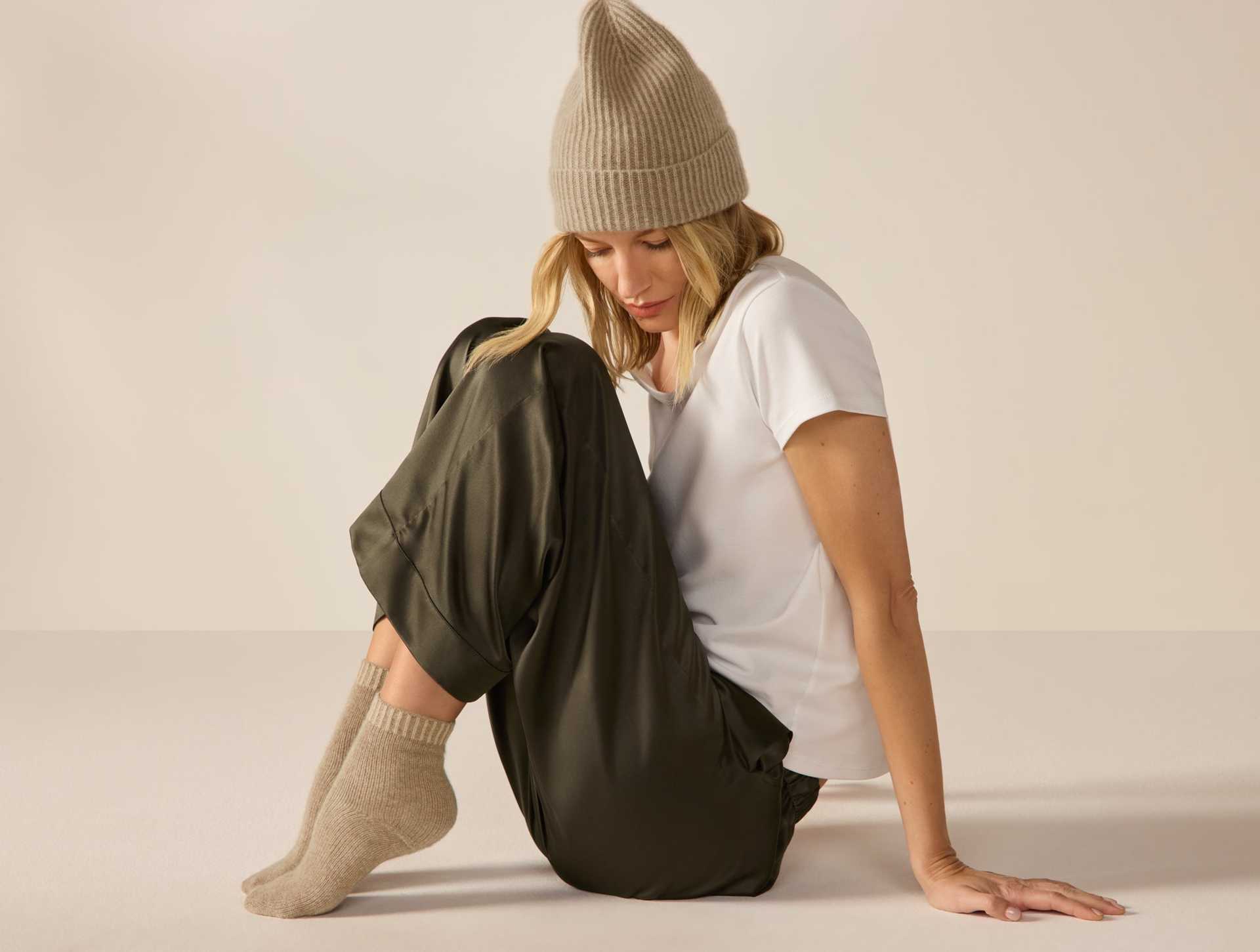
Hats offer a particularly direct example of construction at work. A rib-knit beanie stretches to fit, while a fold-over cuff adds a doubled layer around the ears. The Whitney Cashmere Beanie, made from pure cashmere in a rib knit, uses this familiar arrangement and includes a two-tone detail. Its listed care instruction is dry clean only, an important part of deciding whether the piece suits your habits. A hat that is worn frequently deserves a care plan as much as a pleasing fit.
Warmth without the mythology
Cashmere is valued for insulation, but a garment’s warmth is not determined by its fiber name alone. Thickness, density, fit, and the number of layers all matter. A loose knit may let air move through it; a close, dense one may feel warmer against a draft. A scarf that covers the neck and upper chest can change the experience of a cold day more than a fine sweater worn under an open coat.
Layering works best when it is adjustable. Begin with a comfortable base layer, add cashmere where warmth is needed, and use an outer layer suited to wind or rain. Cashmere is not a substitute for weatherproof clothing. Nor does “natural fiber” mean that a garment cannot become uncomfortable when damp, overheated, or poorly matched to the conditions. The useful advantage is its capacity to provide warmth without necessarily demanding a great deal of weight.
Temperature is personal, and indoor life complicates the calculation. A garment comfortable on a cold walk may feel excessive on a heated bus or in a crowded room. Lightweight cashmere can be appealing in this respect because it is easy to add or remove. But a light layer is only practical if it can be carried, folded, or stored without being crushed or snagged. Everyday usefulness is an arrangement between fabric and routine.
Softness, pilling, and the realities of wear
Pilling is the formation of small balls of fiber on a fabric surface. It occurs when loose fibers work free and become tangled through repeated rubbing. It is common in many soft knits, including cashmere, and can appear where a sweater meets a coat, at the underarms, or along a bag strap. Pilling is not, by itself, proof that a garment is counterfeit or unusable. It is a feature of friction and fiber behaviour, although the rate and amount can vary with yarn, construction, and wear.
Softness may be part of what makes a cashmere garment inviting, but extremely soft does not always mean exceptionally durable. A fabric’s first impression cannot tell you how it will respond to months of contact with desks, seat belts, coat linings, and the ordinary movements of the day. Consider the surface and structure together. A compact, well-finished knit may be more appropriate for repeated use than an especially airy one, even if the latter feels more delicate and luxurious in the hand.
Wear habits can help. Avoid wearing the same cashmere piece every day if it can be rested between uses. Let it air after wearing, and keep it away from rough fastenings and jewellery that might catch the loops. If pills develop, remove them gently with a tool designed for knitwear, following its instructions and working carefully. Pulling at pills by hand can draw out more fibers or distort the surface.
Care that protects the garment
Care instructions are not decorative small print. They are part of the garment’s design and should be checked before purchase, especially for a piece intended for frequent wear. Some cashmere items are marked for hand washing; others specify dry cleaning. The right method depends on the yarn, dye, construction, finishing, and any other fibers in the blend. There is no single rule that responsibly applies to every cashmere garment.
When hand washing is permitted, use cool water and a suitable gentle detergent, and avoid aggressive rubbing or twisting. Rinse carefully, then press excess water out without wringing. Reshape the garment and dry it flat on a clean towel, away from direct heat. Hanging a wet knit can stretch it under its own weight. If the care label specifies professional cleaning, follow that instruction rather than experimenting with a method meant for a different garment.
Between wears, airing is often enough. Cashmere does not necessarily need to be washed after every use, and unnecessary laundering adds handling and wear. When the season changes, clean the piece according to its label before storing it. Fold knitwear rather than hanging it, which can stretch the shoulders or distort its shape. Store it clean and dry in a protected place, with appropriate safeguards against fabric pests. Do not seal away a damp garment.
Care can seem like a tax on luxury, but it is also a way of understanding the object. A sweater that needs more attention may still be worth keeping; the question is whether that attention fits your life. If a dry-clean-only accessory is likely to be worn several times a week, its maintenance may be a sensible trade. If it will spend most of its time waiting for an occasion, the same instruction may feel like an obstacle.
A measured approach to choosing
Before choosing cashmere clothing or accessories, imagine the garment in its actual setting. Will it be worn against bare skin, over a shirt, or beneath a coat? Does it need to stretch? Will a shoulder bag rub against it? Is it meant for short walks, long commutes, or quiet evenings indoors? Those questions reveal more than the word “luxury” can.
- Check the composition. Look for specific fiber percentages, especially when the garment is described as a blend.
- Inspect the construction. Consider knit structure, density, seams, edges, and whether the piece retains its shape after gentle handling.
- Match weight to use. A fine layer is easier to combine with other clothes; a denser knit may offer more substantial warmth.
- Read the care label. Washing and storage requirements are part of the garment’s everyday cost in time and attention.
- Look for clear sourcing information. Specific, verifiable details are more meaningful than unqualified claims about quality or responsibility.
- Think about friction. Bags, coat linings, jewellery, and frequent repetition all affect how a soft knit wears.
Price alone cannot settle the matter. A high price may reflect fiber, workmanship, sourcing, brand position, or some combination of them; it does not independently establish durability or ethical standards. Conversely, a less expensive piece is not automatically unsuitable. The most useful comparison is among the details you can verify: composition, construction, fit, care, and the garment’s likely place in your wardrobe.
The lasting layer
Cashmere is most convincing when it performs without asking to be admired. It is there in the soft hat pulled on before an early walk, the scarf adjusted on a cold platform, the sweater kept at the office for a room that never seems to warm up. Its appeal is not merely softness, but the balance of warmth, weight, and drape that a well-chosen piece can offer.
That balance is made, not guaranteed by a label. Fiber content matters; so do yarn and knit, finish and fit, care and use. Once those details are understood, cashmere becomes less mysterious and more practical. The question shifts from whether it is luxurious to whether it is right for a particular day—and whether it will still be welcome on many days after that.