Queen of Cashmere: An Educational Exploration of Luxury Fiber, Craft, and Care
A premium guide to cashmere’s origins, ethics, and the quiet drama of textile perfection.
The domain queenofcashmere.com invites a conversation that sits at once scholarly and intimate: a close reading of cashmere as material, culture, and discipline. The phrase “queen of cashmere” conjures not merely quality but sovereignty—the sense that the fiber’s lineage, from hillside pastures to Paris runways or Peruvian looms, commands respect. In this article, we chart a path through history, production, quality indicators, ethical questions, and practical care, all while preserving the humane, editorial cadence you might expect from a long-form New Yorker essay about textiles.
This piece blends history, craft, and consumer education into a navigable resource. It foregrounds three distinct voices from different eras—curators, artisans, and scholars—whose ideas illuminate how cashmere has become a benchmark for luxury, sustainability, and tactile pleasure.
A Brief Anatomy of Cashmere
Cashmere is, etymologically and physically, a paradox: a fiber so soft that it feels almost intangible, yet capable of withstanding the rigors of modern wardrobes and domestic spaces. The fiber derives from the soft undercoat of cashmere goats, typically harvested in high-altitude regions where the climate compels the animal to grow a densely insulating layer. When spun into yarn, cashmere becomes the most intimate surface of fabric—filaments that trap warmth while remaining light enough to glide across skin.
The distinction between cashmere and other wools is not merely a matter of texture. It is a question of fiber diameter, crimp, elasticity, and the way the fiber holds loft. A well-made cashmere fabric has a hand that is neither too delicate nor too dull, a balance achieved by careful selection of fibers, blending with complementary fibers, and the precision of weaving or knitting.
Three Time-Traveling Voices: From Antiquity to the Present
Across centuries, distinct figures have shaped how we think about cashmere: a 19th-century textile scholar who mapped the geography of fiber origins, a mid-20th-century artisan who refined production with a philosophy of fiber ethics, and a contemporary curator who treats cashmere as a living archive.
Sir Henry Latham (1803–1879): The Geographer of Fiber Origins
In the long arc of textile scholarship, Sir Henry Latham appears as a precursor to modern supply-chain transparency. Though a product of the Victorian science imagination, his itinerant field notes—collected across northern latitudes and high-altitude plateaus—were less about romance than about mapping where certain wools and fibers could be found at scale and with a degree of consistency. Latham’s liaison with regional weavers, while sometimes idealized in posthumous accounts, planted the seed for later demonstrations that a fiber’s origin cannot be separated from its quality, its ethics, or its environmental footprint.
Adele Moreau (1912–1984): The Artisan Ethicist
Adele Moreau represents a bridge between craft and conscience. A designer and craft advocate, Moreau argued that cashmere’s softness should not be exploited as a shortcut to luxury. Her writings—collected in workshop notes and small-press journals—emphasized traceability, humane animal husbandry, and durable design. Moreau’s voice persists in contemporary conversations about the ethics of sourcing: if a fiber’s story begins with a living creature, then the ethical arc should run through every handshake between mill and merchant, from raw fiber to finished garment.
Dr. Mei Harada (b. 1967): The Curator of Material Histories
In our moment, Dr. Mei Harada curates cashmere as a living archive. Her work treats fibers as cultural artifacts—objects whose meanings shift with fashion, function, and ecological relationships. Harada’s essays insist on seeing cashmere not as a blank luxury but as a record of human ingenuity, climate, geography, and the labor of countless hands. Her approach—interdisciplinary, precise, and humane—offers a template for readers who wish to understand how today’s textile decisions echo past intentions.
Direction A: Educational Resource on Cashmere
The educational approach positions cashmere as a disciplined field of study—one that invites readers to learn about the fiber’s properties, production chain, and ethical considerations without surrendering to sensationalism. It is in this frame that the site can become a reliable, long-lasting reference for students, designers, textile enthusiasts, and curious shoppers.
Core pillars would include histories of origin, the chemistry of fiber properties, the steps from fleece to fabric, quality indicators, and best practices for care. A robust glossary, FAQs, and step-by-step tutorials would anchor the site, while interviews with scholars and industry practitioners would provide depth. The tone remains precise, accessible, and transparent, with a clear emphasis on sourcing and environmental stewardship.
Care and Quality: The Practical Compass
For a fiber as intimate as cashmere, care is pedagogy. The way you wash, store, and wear cashmere communicates respect for the loom, the mill, and the animal. Care guidelines translate complex textile science into daily habits: dry cleaning versus hand washing, temperature control, and storage strategies that preserve loft and softness. The education space does not merely tell you to care—it reveals why care matters, and how small acts of maintenance extend the life of a treasured piece.
In this sense, a care guide becomes almost a philosophy of mindful consumption: buy less, but buy better; value provenance; and honor the labor embedded in each fiber. The approach blends practical advice with cultural context, inviting readers to see themselves as custodians of a fragile yet enduring tradition.
Product Spotlight: The Corvara Scarf
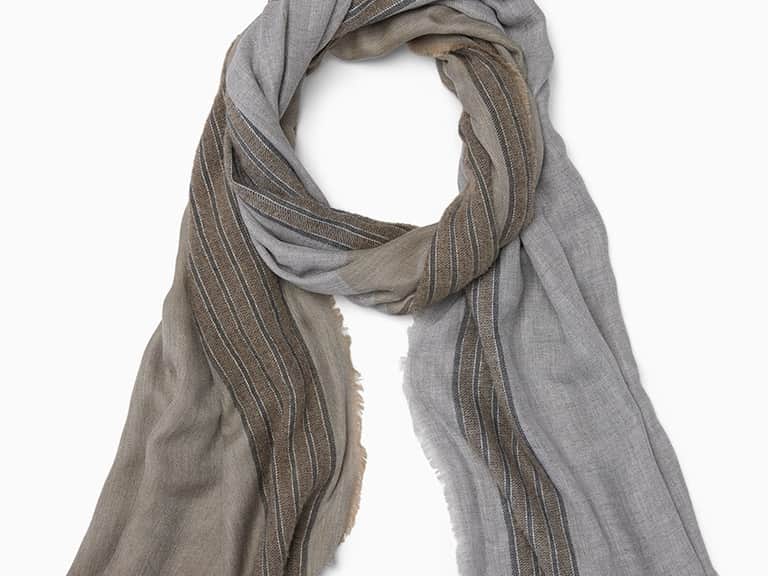
Among the tangible manifestations of cashmere’s refinement is the Corvara Scarf. This yarn-dyed wool blend scarf, with a textured boucle stripe and eyelash fringe, speaks of Italian craftsmanship and a restrained elegance. It is designed not as a loud statement but as a versatile companion to a wardrobe built on quiet confidence.
The scarf’s fiber blend—48% wool, 47% viscose, 5% nylon—delivers a soft hand with lasting drape. Its 28 x 82-inch silhouette offers ample wrap potential without bulk, making it ideal for layering through changing temperatures. Dry clean only, the Corvara Scarf is a curated addition for readers who appreciate the intersection of tactile pleasure and disciplined construction.

Glossary and Guided Learning
A cornerstone of the educational resource is a glossary that translates textile terms into accessible explanations. Terms like “nap,” “loft,” “knit vs weave,” “guaranteed origin,” and “silk mohair blend” can be the difference between confusion and comprehension. Each entry would offer practical notes on when and why a term matters for cashmere, how it influences care, and what it reveals about the fiber’s performance.
The pedagogy should extend to checklists, such as a “Quality Indicators for Cashmere” that guide readers through fiber diameter considerations, fiber length uniformity, twist, pilling resistance, and stitching longevity. With clarity, the site becomes a trusted teacher—an antidote to superficial shopping guides that promise luxury but deliver ambiguity.
Practical Steps: Building Your Cashmere Library
To help readers assemble a thoughtful, durable collection, the site might publish a curatorial guide to essential pieces: a versatile scarf (like the Corvara Scarf), a premium throw, and a foundational cardigan. Each item would be presented with a brief provenance note, care instructions, and a discussion of how its materials contribute to its function and longevity. The goal is not merely to decorate a space but to illuminate the choices behind premium textiles.
The product spotlight can be expanded responsibly to include a few carefully chosen items from the existing catalog, all while maintaining the site’s non-commercial, educational stance. The Corvara Scarf already demonstrates how a single accessory can embody both technical sophistication and wearable poetry.
Aesthetics and Tone: The Language of a Timeless Site
The site’s visual and textual language must feel timeless—an aesthetic that aligns with the moral cadence of a New Yorker feature: precise, reflective, and quietly authoritative. The typography should be generous, with ample line-height for readability; the color palette should be restrained—charcoal, ivory, warm stone, and muted blues—to evoke a sense of calm authority. The interface should be uncluttered, focusing on the joy of learning and the beauty of well-made textiles.
The ethical dimension should be built into every page: sourcing transparency, labor practices, environmental considerations, and the social responsibilities of the cashmere supply chain. By foregrounding ethics, the site could become a model for educational platforms that treat luxury not as an exclusionary spectacle but as a field of serious inquiry and humane practice.
Conclusion: A Non-Commercial Manifesto
Queen of Cashmere as a project is a manifesto for knowledge. It argues that luxury fibers deserve rigorous analysis, careful stewardship, and clear, generous writing. It invites readers to inhabit a world where cashmere is not merely a status symbol but a subject of inquiry—one that rewards curiosity, discipline, and care.
If you are building a site that educates rather than advertises, this article provides scaffolding for a robust content plan: histories, production processes, quality identification, care guides, ethics, glossaries, and expert insights. It also offers a practical entry point—a product spotlight that exemplifies the fusion of craftsmanship and luxury—without compromising the site’s scholarly, non-commercial identity.
This article features a curated product spotlight and a hypothetical trio of voices across eras, illustrating how the dialogue around cashmere can be both scholarly and human.